Key points
- Put the expiry rule on the page where a student buys the pass, not only in your head.
- Show the price per class next to a block, so the saving is visible before the student buys.
- Decide your cancellation cutoff and whether a credit goes back, then apply it to everyone.
- When a balance is wrong, add a dated correction with a note rather than typing over the number.
- Keep a dated record of every sale, use, refund and correction, so any balance can be explained.
In this guide
A class pass is the simplest way to keep regulars coming back, and the quickest way to lose their trust if it goes wrong. Most problems come from three decisions: how long a pass lasts, how its price compares with a single class, and what happens when someone cancels. This guide covers those, then how to correct a balance without losing its history. None of it depends on the software you use. Where we describe how Flows With does something, we say so.
How long a pass should last
Expiry causes most of the arguments, so decide it once and write it down. There are four common ways to set it.
- No expiry. Simple to explain, but a pass may stay open for years, and some students will then ask for classes you had forgotten about.
- A set number of days from purchase. Easy to explain. Make the number long enough for someone who misses a few weeks.
- A set number of days from the first class booked. Kinder to someone who buys just before a holiday, but every student then has a different end date, which is harder to keep track of.
- A fixed end date, such as the end of a term. It suits a timetable that runs in terms, but a student who buys late in the term gets fewer classes for the same money, so say so on the page.
Whichever you pick, put the rule where a student buys the pass, not only in your head. A rule that appears only in a reply to a message after the purchase is a rule you will have to defend.
Pricing a block against a drop-in
Start with your drop-in price, then work out the price per class in a block, and check that the saving is one a student will notice. Here is an example with made-up figures. A drop-in costs £12. A block of ten costs £100. Each class then costs £10 in the block, a saving of £2 a class, or about 17%.
The discount is a judgement. A bigger one persuades more people to buy ahead, but it lowers what you earn on every block sold. Two checks help. First, how often a regular comes. A weekly student will use a ten-class block in about ten weeks, and a fortnightly one in about twenty. If your expiry is three months, the fortnightly student may never use the block in time. Second, whether students who buy blocks miss classes. Your attendance records will show this, and it changes what the block is really worth to you.
Show the price per class next to the block on your booking page, so the saving is visible before the student buys, not worked out later at the door.
Cancellations
Decide two things, write them down, and apply them the same way every time: whether a student who cancels in time gets the class back on their pass, and how long before the class that cutoff falls. Then decide what happens when you cancel a class. A fair answer, and an easy one to defend, is that every student who used a pass credit for it gets the credit back, because they did not choose to lose it.
After the cutoff, you can keep the class used. The point is less which rule you choose than that the student can read it before they book, and that you apply it to everyone.
In Flows With the rule works like this. A student who cancels before your cutoff gets the credit back to their pass, unless your cancellation terms give nothing back. After the cutoff the class stays used, and the cancel screen says so before they confirm. If you cancel a class, every credit used for it goes back to its pass, and everyone booked is told by email. A pass covers your weekly classes. It covers a workshop only if you say so, so a £35 workshop is not booked with a £9 credit by accident.
Which pass gets used first
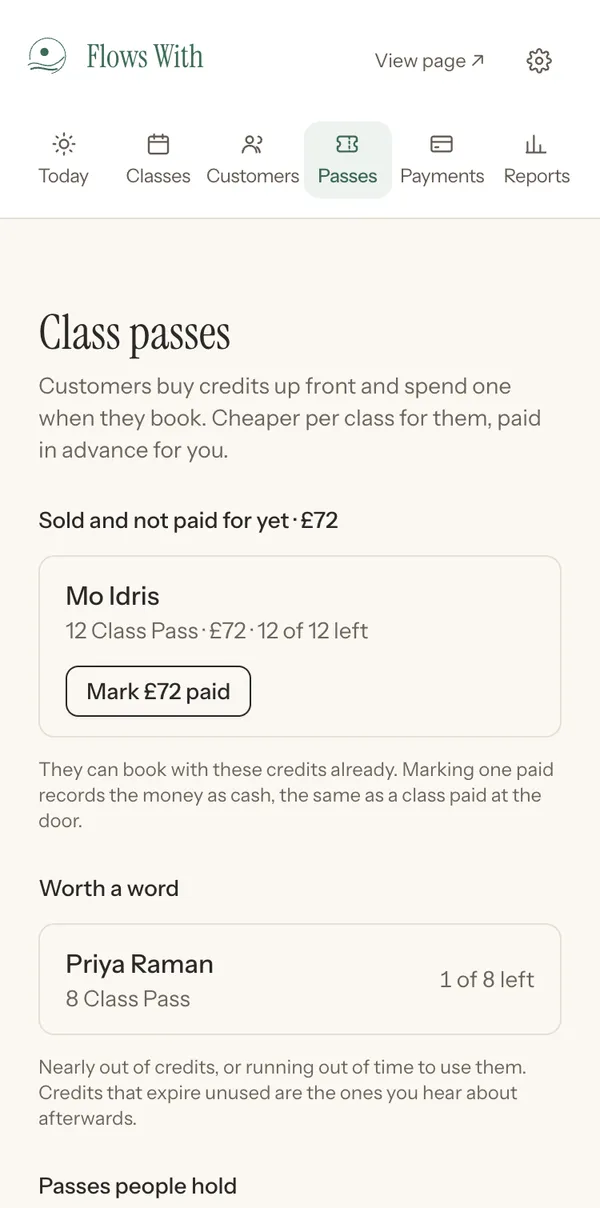
A student with two passes needs a rule for which one is spent. A sensible default is the pass that expires soonest. That way nothing is wasted, and the student can see which pass a booking will use before they confirm. Write the rule on the booking page, because students who hold more than one pass will ask.
Fixing a wrong balance
Balances go wrong. A cash block was never written down, two passes were merged, or a student says they have three classes left and your record says one. The temptation is to type over the number. Resist it. A typed-over number cannot show how it went wrong, so the next dispute starts with no evidence.
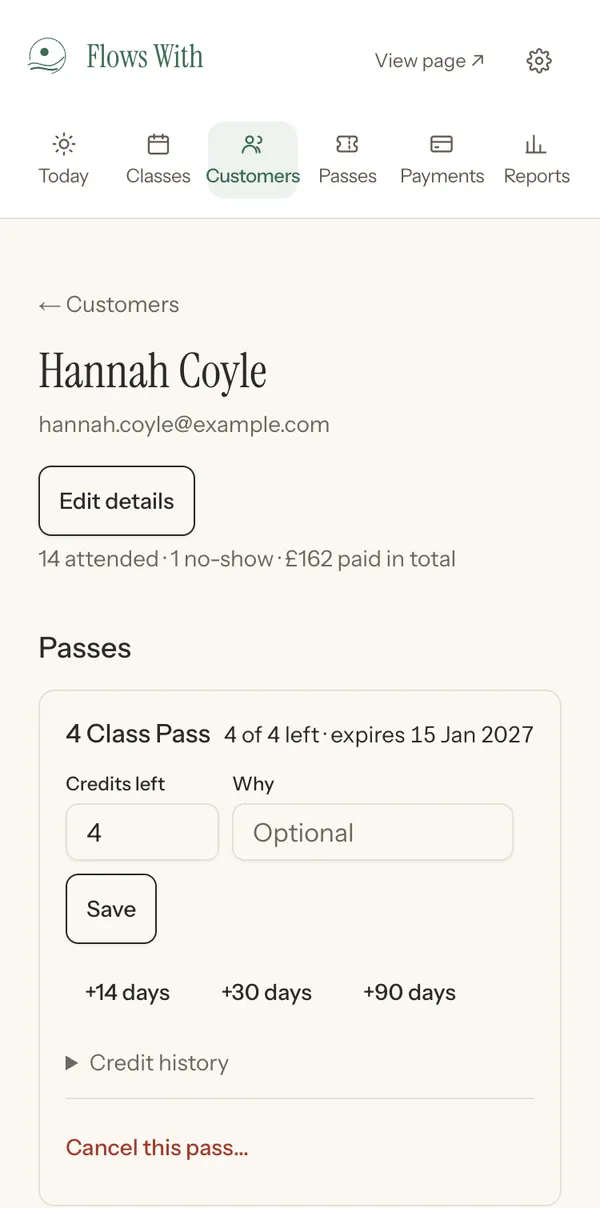
Correct it as a change instead, with a note. Each change records what it was, by how much, and why. Then a student who asks why they have two left gets an answer from one page: eight bought, one used for each class they booked, one returned for a cancellation, and one added after a cash payment was found.
- Look at the history first. Most disputes are a missed booking or a double count, not a lost pass.
- Work out the balance that is right, and the difference from the balance you hold.
- Make one change for that difference, with a note saying what happened.
- Tell the student what you changed and what they now have, in a short message.
A typed-over number cannot show how it went wrong.
Keeping a history you can read
A balance you can explain is worth more than one you can change. Whatever system you use, keep a dated record of every sale, every class used, every refund and every correction. A spreadsheet will do if you add a row for each change and never overwrite a row.
This is how our software holds a pass. The balance is the sum of the changes recorded against it, and nothing overwrites them. A correction is a new line, extending an expiry date is recorded too, and no background job changes a balance. You can read how passes and credits work in the software on our class passes page, and what it costs on our pricing page.